
Large churches have always attracted attention. They are visible, often influential, and frequently serve as models for other congregations. But what happens when the number of large churches begins to shrink?
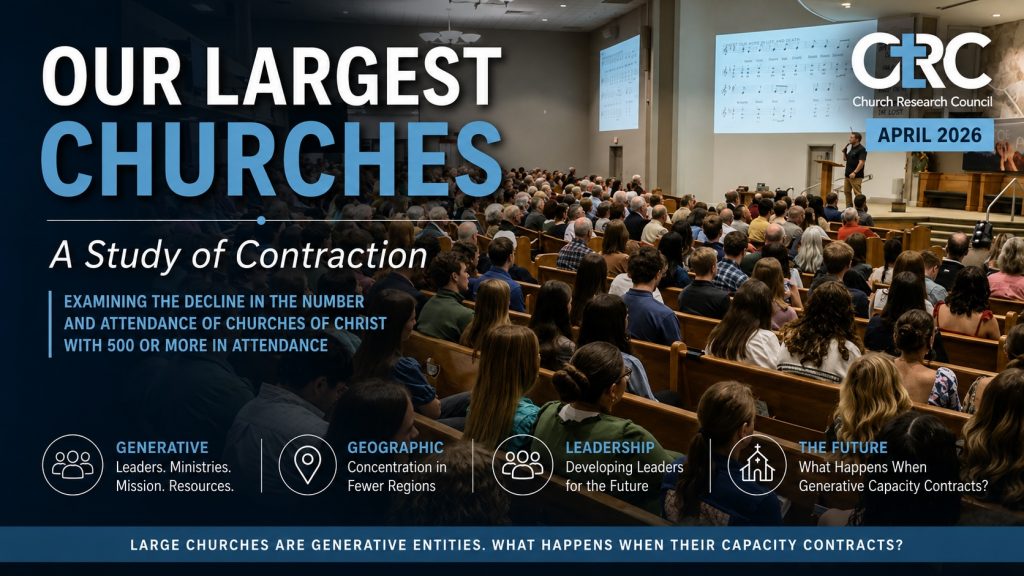
The Church Research Council’s April 2026 Insight Report, Our Largest Churches: A Study of Contraction, examines the largest congregations in Churches of Christ and finds a significant contraction in both their numbers and their attendance.
The report focuses on congregations averaging 500 or more in attendance. These churches occupy an important place in the life of the fellowship because they operate differently from smaller congregations. As churches grow, their leadership, staffing, programs, and organizational structures become increasingly specialized. The result is a different kind of congregational capacity.
Why Large Churches Matter
Large churches are more than simply bigger versions of small churches. As congregations grow, they develop specialized ministries and deeper leadership structures. A church of 500 or more may have ministers responsible for preaching, worship, children, youth, family ministry, outreach, benevolence, technology, and other areas. Rather than depending primarily upon generalist leadership, larger churches can develop specialists who devote their attention to particular ministries.
These churches also tend to be mission-driven. Their mission is not merely a statement displayed on a wall; it becomes a framework for deciding what the church will do. Large churches also tend to pay attention to the communities around them, seeking measurable ways to respond to local needs and developing partnerships with other churches and community organizations.
Perhaps most significantly, larger congregations can generate ministries that extend well beyond the local church. They can support missionary work, church planting, specialized ministries, and programs that serve congregations across the fellowship. For this reason, the report describes large churches as generative entities. They generate ministers, ministries, mission, and financial resources that can benefit the wider movement.
The Numbers Tell a Different Story
The data, however, reveal a substantial contraction. Among churches that averaged 1,000 or more in attendance in 2018, the number reporting at that level fell from 38 to 21 in 2026. Eighteen churches dropped out of the category, while only one church grew into it. Total reported attendance among these churches declined by 18,454 people, or 37%. The median attendance also declined, from 1,200 to 1,150.
The next category tells a similar story. In 2018, there were 41 churches averaging between 750 and 999 in attendance. Of the 40 for which 2026 information was available, only three increased in attendance. Their total attendance declined from 34,587 to 22,230, while the average Sunday attendance fell from 844 to 556. That represents a 36% decline among these reporting churches.
The contraction extends into the 500–749 category as well. In 2018, 121 congregations were in this range, representing more than 70,000 in reported attendance. These churches constituted only about 1 percent of congregations but accounted for 6% of total reported attendance. By April 2026, the CRC had received information from 105 of those 121 churches, providing a substantial picture of what had happened over the intervening years. Taken together, the pattern is difficult to dismiss as simply a change in a few individual congregations.
Contraction Is Also Geographic
The report finds that contraction is not limited to the number of large congregations. It is also geographic.
The larger churches of Churches of Christ have become increasingly concentrated in the traditional southern heartland. Texas, Tennessee, Arkansas, and Alabama contain the largest concentrations, with Oklahoma also prominent. The Nashville and Dallas–Fort Worth metropolitan areas emerge as the two major centers of large-church presence. This matters because the presence of large churches is part of the infrastructure through which a movement reproduces itself.
When a large church disappears from a region, the loss is not simply one congregation and fewer members. The region also loses the specialized ministers, ministry programs, financial resources, leadership-development opportunities, church-planting capacity, and connections to broader mission activity. The report notes, for example, that large churches often support multiple mission works and play an important role in launching new campuses and planting churches in other communities.
A Different Kind of Leadership
One of the most interesting observations in the report concerns leadership. Small churches can provide important entry-level opportunities for emerging leaders. But large churches require a deeper level of organizational leadership. The report describes this as “three-deep leadership”—leaders who lead teams of leaders and provide operational and strategic leadership for the larger body.
As congregations become more complex, they need leaders who can think beyond individual tasks and develop systems, teams, ministries, and strategies for the future. This creates an important connection between church size and leadership development. If there are fewer large churches, there may also be fewer environments in which specialized ministry leaders and higher-level organizational leaders can be developed.
The Question Behind the Numbers
The report’s findings raise a larger question for Churches of Christ:
What happens to a movement when its generative capacity contracts?
The answer is not simply that fewer people attend large churches. The potential consequences reach much further. Large churches provide resources and models from which smaller congregations can benefit. They support missionaries and specialized ministries. They create opportunities for specialized ministers. They develop programs that can serve people beyond their own congregations. And they provide environments in which increasingly complex forms of leadership can develop.
That does not make large churches more important than small churches. The two serve different roles. The CRC’s companion Insight Report on small churches describes small congregations as anchors—providing geographic presence, relational continuity, and stability. Large churches, by contrast, have a greater capacity to be generative, creating and distributing resources throughout the larger movement. A healthy movement needs both.
What Does the Future Hold?
The Our Largest Churches report does not suggest that large churches are destined to disappear. Nor does it argue that numerical growth is the only measure of congregational health. Instead, it asks us to recognize what large churches contribute to the larger ecology of Churches of Christ—and to take seriously the consequences of their contraction.
The data from 2018 to 2026 suggest that the fellowship has fewer large congregations, fewer people attending those congregations, and a growing concentration of large churches in particular geographic regions. That should prompt more than concern about attendance statistics. It should prompt questions about leadership development, church planting, mission, ministry innovation, and the future geographic reach of Churches of Christ.
The challenge is not simply to produce bigger churches. It is to create an environment in which churches can reproduce leaders, ministries, mission, and churches—and to understand what happens when that generative capacity begins to contract.
The Church Research Council’s Our Largest Churches: A Study of Contraction provides the data for beginning that conversation.