
What does it mean that the majority of Churches of Christ in America are small churches?
It is a question worth asking. While attention is often drawn to large and growing congregations, the reality is that most Churches of Christ are much smaller. The Church Research Council’s Insight Report: Small Church Realities examines an easily overlooked part of our fellowship and considers both the strengths and challenges of small congregations.
The report grows out of the CRC’s ongoing effort to better understand Churches of Christ across the United States. Beginning in August 2024, the CRC surveyed congregations about demographics, worship practices, discipleship, community engagement, and congregational leadership. More than 2,500 congregations have provided survey information, while the CRC continues to review and update its national database.
A Small-Church Fellowship
The data reveal something important about the character of Churches of Christ: we are primarily a small-church fellowship.
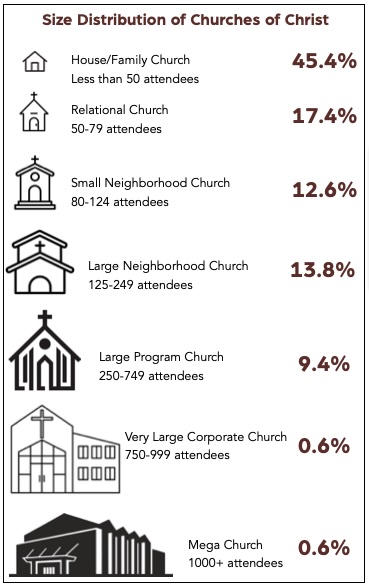
The report estimates approximately 9,500 congregations with total attendance of around 960,000. More than 60 percent of these congregations fall within the smallest size categories. In the CRC’s 2018 distribution, 45% of congregations were House/Family churches with fewer than 50 attenders, while another 17% percent were Relational churches with 50–79 attenders. Overall, approximately 75 percent of congregations were below 125 attenders.
Among the 2,500 congregations that completed the CRC survey, the median attendance was 55, with a median membership of 53. These numbers help put the typical congregation into perspective: the small church is not a marginal phenomenon within Churches of Christ. It is the norm.
Small Churches Are More Than Small
The report describes the smallest congregations as anchors within the fellowship. An anchor provides stability, even though its very purpose is to keep something from moving.
That image captures an important strength of small churches. Their geographic reach gives Churches of Christ a presence in a remarkable variety of communities and social settings. The report notes that Churches of Christ have congregations in all fifty states and in 2,391 of the nation’s 3,244 counties. Small congregations provide local knowledge and a continuing presence in places where larger churches may have little or no presence.
Small churches also provide continuity. Their relational character can make them places of safety amid rapid cultural change, preserving connections to the history and traditions of the fellowship. And because many cannot support paid ministers, they often depend upon volunteer leadership. That creates opportunities for ordinary members to teach, lead, serve, and develop their gifts.
In other words, small churches should not be evaluated only by what they cannot do. They also contribute something distinctive to the life of the fellowship.
The Challenges Are Real
At the same time, the report does not romanticize small churches.
Their strengths can also become limitations. Small congregations tend to be resistant to rapid change. They frequently operate with limited financial and leadership resources, and the loss of even one key person can substantial impact their ability to function. Their resources are dispersed across thousands of congregations, making those resources difficult to access.
Small churches, with their broad geographic dispersal but limited resources, can make it difficult to retain or develop leaders with greater capacities. Smaller churches often receive ideas, energy, and resources generated elsewhere rather than serving as the primary launch points for new initiatives.
This leads to one of the report’s most important observations: small churches are generally not movement-making churches. They are downstream participants in the movement.
How Should We Engage Small Churches?
If that is true, then the goal should not be to make every small church into a large church.
Instead, the report argues for a different approach: recognize small churches for what they are and find ways to connect them to resources, relationships, and opportunities that can strengthen the people within them.
This might include regional activities, enrichment opportunities, camps, mission trips, and spiritual-growth experiences that individual small churches could not provide on their own. Young people in small congregations, for example, can benefit from regional opportunities that connect them with larger groups of peers. The report also recommends keeping small churches informed about regional initiatives and creating opportunities for their participation, including financial assistance when necessary.
Perhaps most importantly, the report cautions against expecting small churches to be early adopters or primary agents of change. Their role is different. They are part of the larger ecosystem, receiving and adapting the energy generated elsewhere.
Small Churches Matter
The conclusion is both simple and challenging: the future of Churches of Christ cannot be understood without understanding its small churches.
They constitute the majority of our congregations. They provide geographic breadth, relational depth, historical continuity, and opportunities for leadership development. At the same time, their limited resources and leadership capacity mean that they need to be engaged differently from larger congregations.
The challenge, then, is not simply to ask how we can make small churches bigger. It is to ask how the larger fellowship can better understand, support, and engage the people who worship in these congregations.
As the report puts it, “Small churches are people too!”
Understanding that reality may be an important step toward understanding the future of Churches of Christ.