
Those of us in the Churches of Christ and Independent Christian churches are typically aware that both our fellowships share the history we call the Restoration Movement. What we are often not aware of is just what a movement of churches is, how movements develop, and what they look like as they move through a lifecycle.
The new In-Depth Report, Anatomy of a Movement: California, 1849-2025, prepared by the Church Research Council, examines the history and present condition of California Churches of Christ through the lens of a movement. Drawing on historical sources and three major datasets, the report traces the movement’s development from its earliest beginnings in 1849 through its remarkable twentieth-century expansion and into its present period of decline.
From Expansion to Deceleration
For much of the twentieth century, the California story was a story of reproduction. Churches planted churches, leaders trained leaders, and the movement continually extended its geographic reach. The decades from the 1940s through the 1960s were especially productive years for church planting. By the 1970s, however, new church planting had begun to decline sharply, and very few new congregations have been established in the twenty-first century.
The California historical data suggests that the 1980s marked an important turning point for the California movement. The number of congregations remained high, buildings were full, and attendance was still substantial. Yet the movement’s underlying momentum was beginning to slow. Between 1980 and 2003, the number of California congregations actually reached its high point of 698, but attendance declined from 68,942 to 61,884.
This is where the Church/Movement Lifecycle becomes particularly helpful.
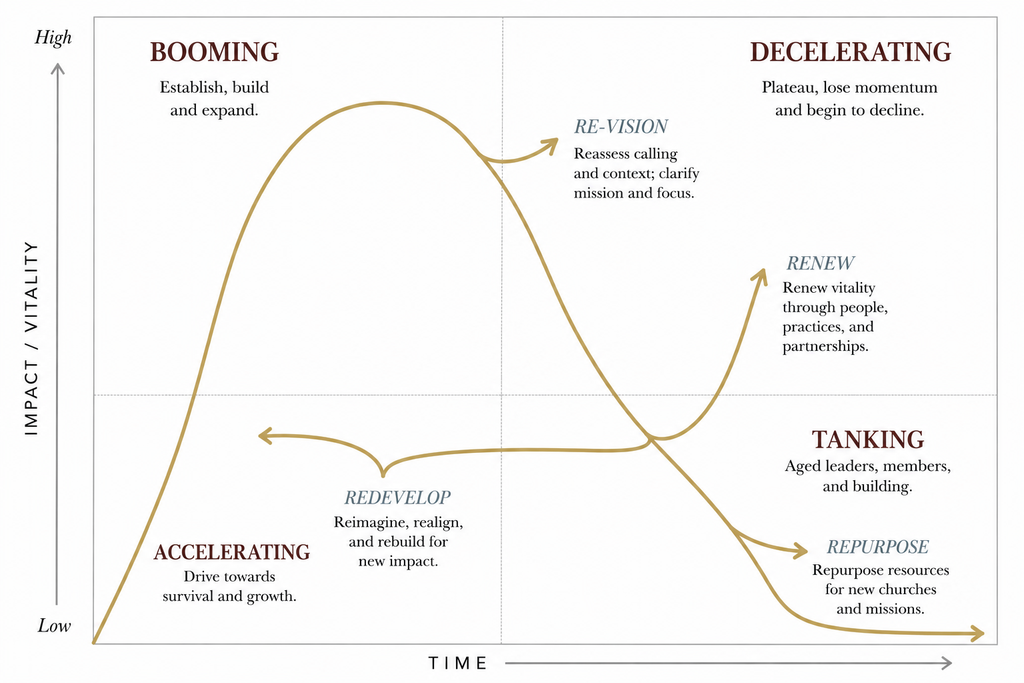
Figure 5 of the report identifies four broad lifecycle stages: Accelerating, Booming, Decelerating, and Tanking. The California movement appears to have moved from its accelerating years during the first decades of the twentieth century into a prolonged period of expansion and “Booming” from roughly 1940 to 1980. Between 1980 and 2003, however, the movement appears to have crossed the top of the curve into Deceleration.
The significance of this observation is not simply that California churches began to decline. Rather, the movement reached a point at which renewal and reproduction became essential. The report argues that the opportunity existed in the 1980s and 1990s to create a new upward trajectory while the movement still possessed substantial people, resources, and opportunities.
The Numbers Tell the Story
By 2018, the trend was unmistakable. California had declined from 698 congregations in 2003 to 580 in 2018. Attendance fell from 61,884 to 48,105—a loss of 13,779 people. At the same time, the average California congregation was 62 years old, and the youngest identified congregation had been planted in 2016.
The 2025 data shows that the decline has continued. The number of congregations has fallen to 471, while attendance declined to 37,833. From 2018 to 2025, the number of churches decreased by 109, while attendance declined by 10,272. From 2003 to 2025, California lost 227 congregations—an overall decline of 33%.
Perhaps as significant as the decline already experienced is the age of the remaining churches. Of the 427 congregations for which a founding year is known, the average church is now approximately 70 years old. Almost half of California’s congregations fall into a combination of age and attendance associated with a high risk of closure. This situation presages an increasingly steepening closure of churches in the near future.
A Challenge to Reproduce
The report’s central concern, therefore, is not simply decline. It is reproduction.
Healthy church movements reproduce more than congregations. They reproduce leaders, vision, ministry practices, missionary imagination, and the capacity to engage succeeding generations. When these reproductive processes slow, church planting slows. Eventually, the movement begins to age without replacing itself.
The California experience offers both a warning and an opportunity. The history demonstrates what can happen when a movement engages an ecology that leads to reproduction. The present state of the California Churches of Christ demonstrates what happens when that movement ecology erodes and reproduction ceases. This raises raises a crucial question for the future:
Can an aging movement rediscover the vision, leadership, courage, and missionary imagination necessary to reproduce itself again?
The California In-Depth Report does not claim to provide a simple answer. Instead, it provides the historical record, the demographic evidence, and a framework for thinking about the challenge.
We invite you to read the full report and consider what the California experience may teach all of us about the future of Churches of Christ.